When revenue stalls, most owners decide their small business marketing needs more reach and turn to paid advertising. Sometimes that works. But if your business already loses potential customers somewhere in its sales process, ads only send more people into the same gap. Local SEO for small business is usually the cheapest place to start, because the tools that matter most in local search results are free.
This guide uses data from a Halifax appliance repair company whose marketing our team managed in 2026. It spent almost nothing on advertising, yet its Google Business Profile generated 99 phone calls in six months. Below, we explain how to get more customers with the same approach.
Key takeaways
- Revenue depends on four numbers that multiply together, so improve the weakest one before you buy more traffic.
- Effective local SEO combines a complete Business Profile, steady reviews and pages that answer specific customer questions.
- In our Halifax example, detailed troubleshooting articles attracted far more search traffic than general service pages.
- Before choosing between SEO vs Google Ads, calculate the cost per customer. At $25 per lead and a $120 average job, ads did not pay for that business.
Revenue comes from four numbers
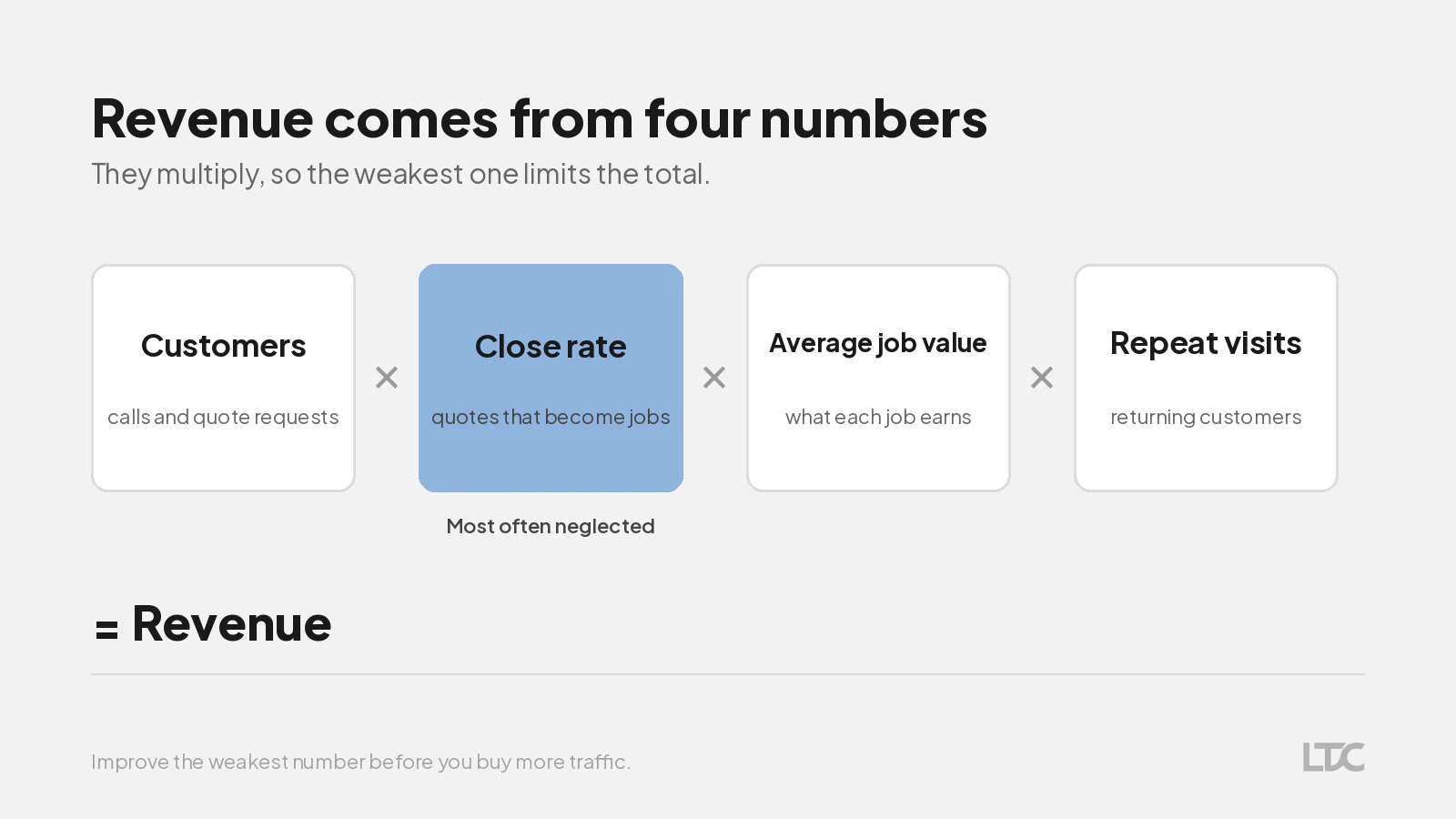
Every local business earns revenue through the same equation:
Revenue = customers × close rate × average job value × repeat visits
Because the four numbers are multiplied, a weak result in one area limits everything else. A plumber who receives plenty of calls but closes only 10% of quotes will earn less than a competitor with half the calls and a 40% close rate.
Before you change your marketing strategy, measure each number: last month’s calls and quote requests, the share that became paid jobs, whether your prices or add-on services have changed this year, and how often you contact past customers. In our experience, close rate is the number owners most often neglect, because inquiries arrive and nobody follows up.
Not sure which number is holding your business back? Book a free 30-minute audit and we will show you where the leak is.
Book your free auditFind the leak first: the five stages of getting a customer
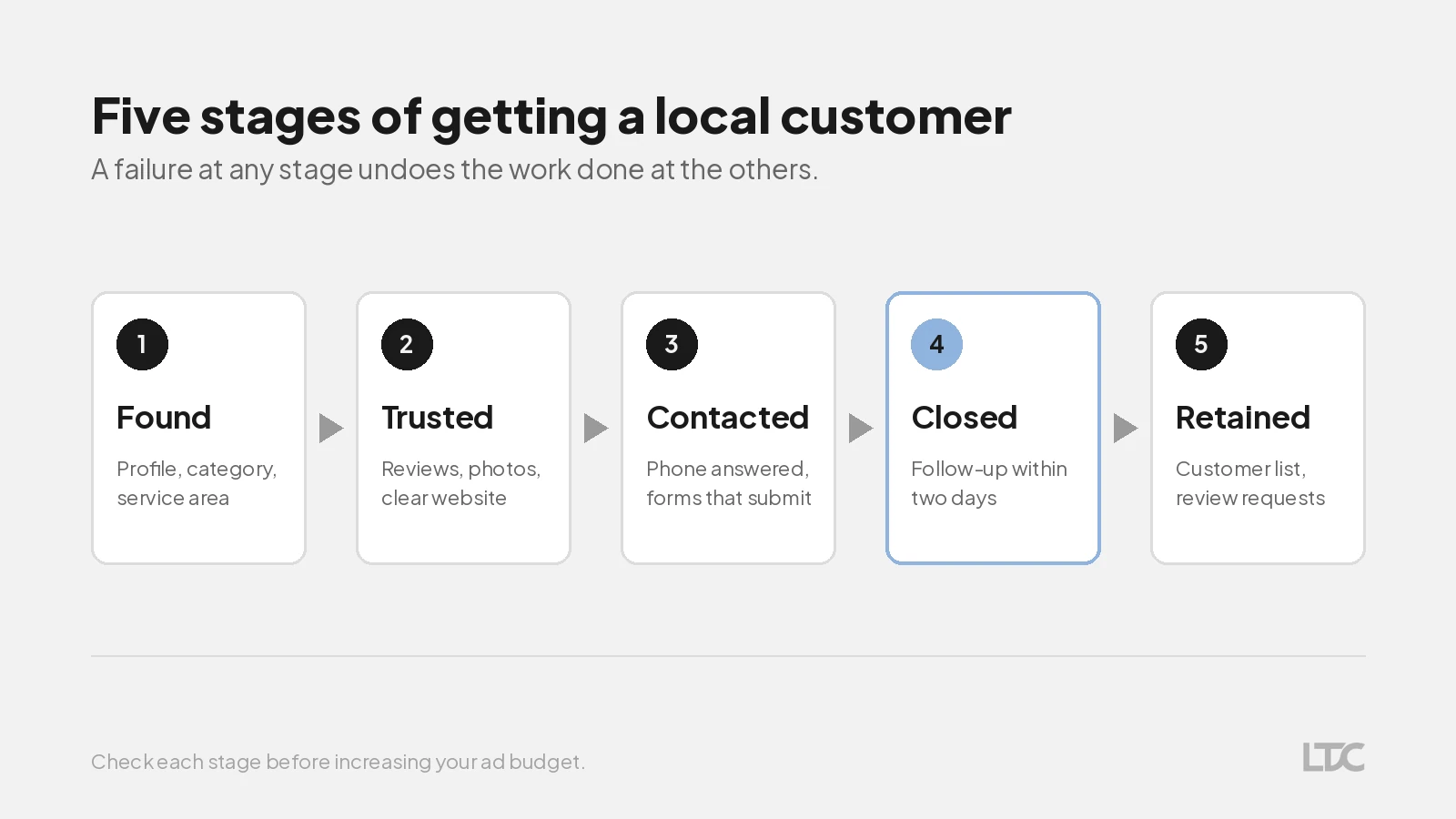
Before a customer pays you, they move through five stages, and a failure at any one can undo the rest.
| Stage | What a problem looks like | What to check |
|---|---|---|
| Found | You do not appear when people search for your service and city | Profile status, primary category, service area |
| Trusted | Customers find you but choose a competitor | Number and age of reviews, photos, website clarity |
| Contacted | Customers try to reach you and fail | Phones answered during business hours, working forms |
| Closed | Customers request a quote and go quiet | Follow-up within two days of every quote |
| Retained | One job, then no further contact | Customer list, review requests, seasonal reminders |
When we took over the marketing for a home services company in the GTA, the owner wanted more advertising. Our review found that the phone field on the contact form used the wrong format, so customers could fill it in but never submit it, and nobody tracked phone taps on mobile devices. More ads would have sent more visitors to a broken form.
What local SEO for small business involves
Search engine optimization (SEO) helps your website and business profile appear when people search for what you offer. Local SEO focuses on searches tied to a location, such as “furnace repair Dartmouth” or “dentist near me,” and covers two areas: the Google Maps results at the top of the page and the organic rankings below them.
According to Google’s own guide to local ranking, map results depend on relevance, distance and prominence. Relevance measures how well your profile matches the search, distance measures how far you are from the searcher, and prominence reflects how well known your business is. You cannot control distance, but the steps below improve the other two.
1. Complete your Google Business Profile
For many customers, your Business Profile is the first impression of your company, and it costs nothing to create. Choose the primary category that matches the search terms customers use, and compare it with the categories of the three competitors that rank highest.
List every service you provide, because each one gives Google another reason to match your profile to a search. If you travel to customers, include only the areas you serve, and publish a phone number that someone answers during your listed hours.
Every entry should describe a service you provide today, because Google can suspend profiles that appear inflated or misleading, and reinstatement is slow.
2. Ask every customer for a review
Reviews help you rank higher and build trust with customers who are comparing you with a competitor. Ask every customer on the day you complete the job.
Google’s review policy sets clear limits. Businesses may not offer discounts or gifts for reviews, ask only satisfied customers, request specific wording or set review quotas for staff. Google may remove reviews that break these rules, so a short text message with your review link is the safest approach.
3. Keep your contact information consistent
Your business name, address and phone number should match exactly across your website, Google Business Profile, Yelp, HomeStars and other directories, because inconsistent contact information makes search engines less sure which details are correct. Avoid adding keywords or city names to your business name on Google, since it puts the profile at risk.
4. Create content that answers customer questions
Many small business websites consist of a home page, a services page and a contact page, with nothing that answers the questions customers type into Google. Google’s guidance on helpful, people-first content favours pages that show first-hand experience and real expertise. For a repair company, that means a page explaining why a particular washer will not drain, written by a technician who has fixed that problem many times.
Pages like these, along with focused landing pages for each of your products or services, drive traffic from people who already have a problem to solve. Keep them current, so search engines keep showing them to your target audience.
Results from one Halifax business
The appliance repair company registered in April 2026, and active marketing began in May with the steps above.
stopped taking jobs in late August.
| Month | clicks |
|---|---|
| May | 37 |
| Jun | 124 |
| Jul | 201 |
| Aug | 343 |
| Sep | 272 |
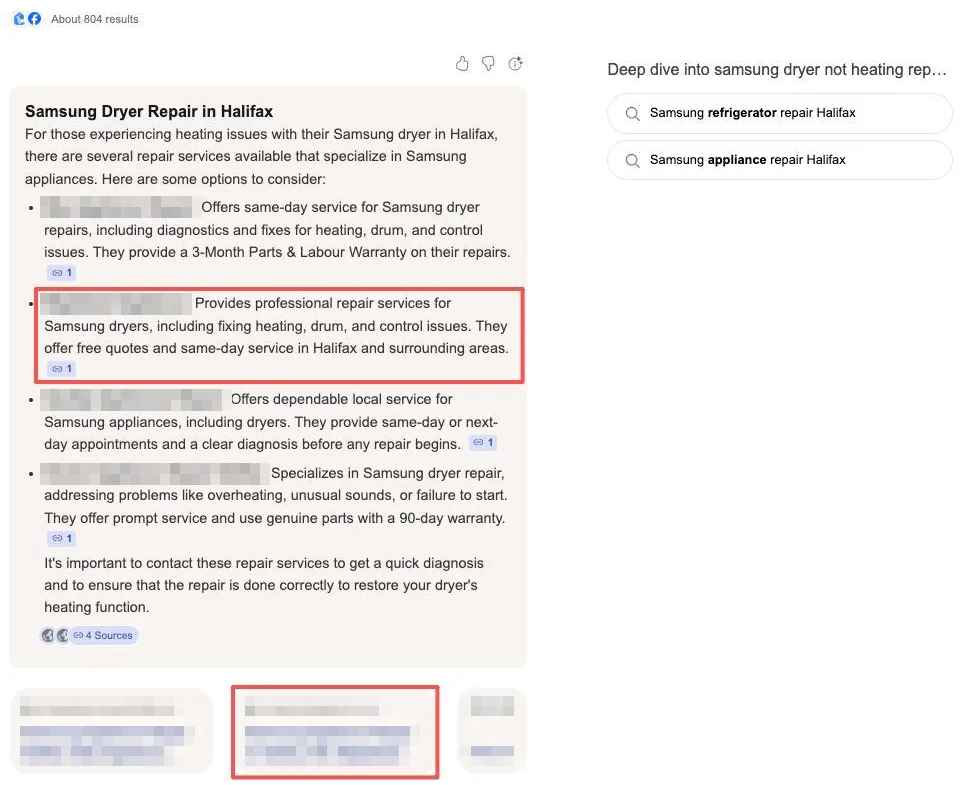
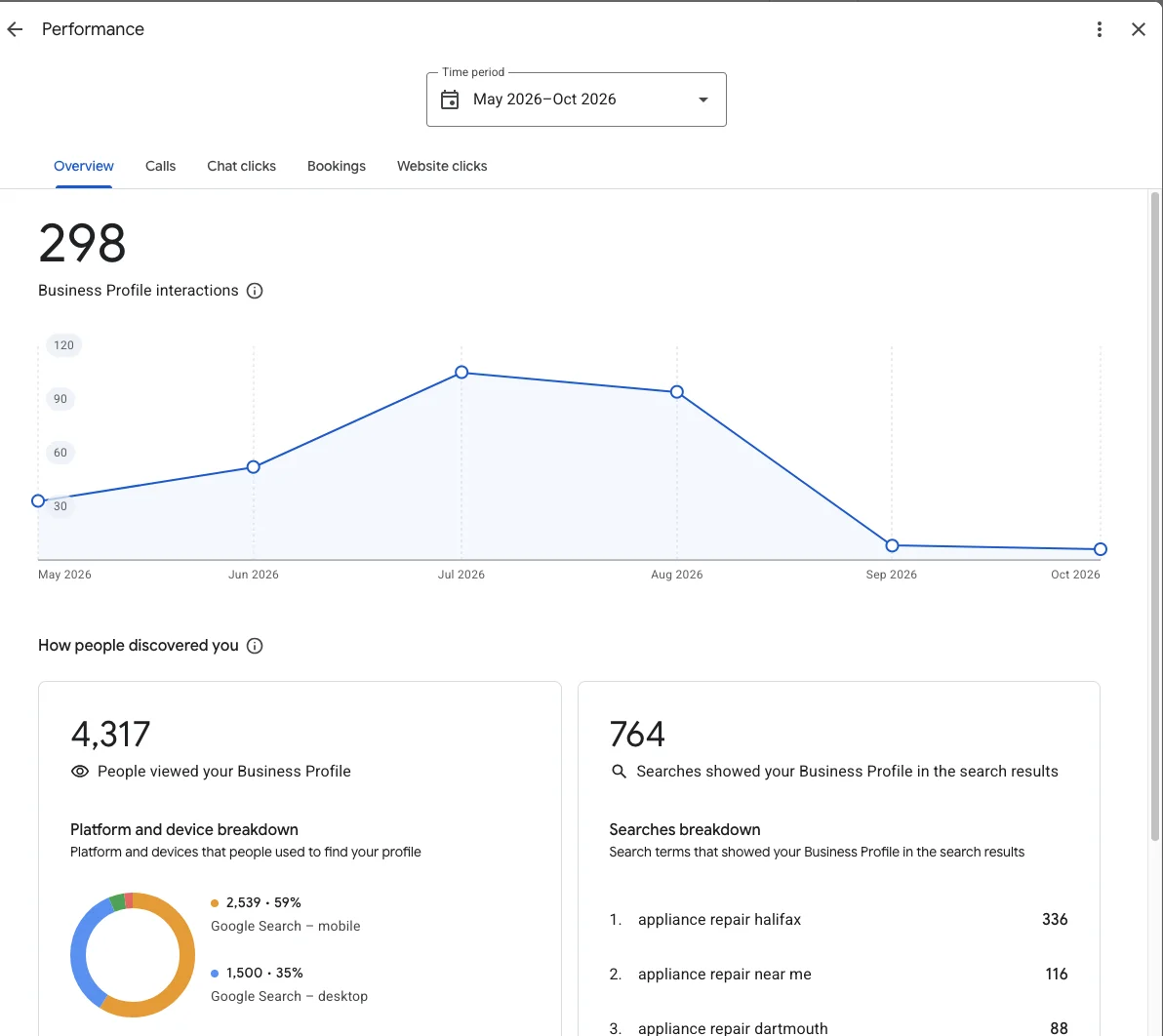
According to Google Search Console, search clicks rose from 37 in May to 124 in June, 201 in July and 343 in August. Over the same period, the website’s average position improved from 26.8 to 10.9. Between May and October, its Business Profile recorded 4,317 views, 99 calls and 194 website clicks, supported by 22 five-star reviews. On May 27, roughly two weeks after the work began, Google’s AI Overview cited the website for the first time.
The strongest pages were troubleshooting articles rather than service pages. An article about a dryer that would not heat earned 194 clicks at an average position of 6.7, and an article about a washing machine that would not drain appeared in search results more than 21,000 times. Without any advertising budget, the business booked two to three jobs a day from search.
The company stopped accepting jobs in late August, after its technical partner left. Customers still called most days through September and into October, mainly through the number on the website.
SEO vs Google Ads: calculate before you spend
Owners often ask whether $20 a day on Google Ads is enough. A more useful question is how many calls $20 a day will produce.
| Step | Example |
|---|---|
| Daily budget | $20 |
| Cost per click | $8 |
| Clicks per day | 2.5 |
| Share of clicks that call | 10% |
| Calls per month | About 7 |
These figures are illustrative, but they show why the choice between SEO and Google Ads depends on volume: at seven calls a month, it is difficult to judge whether a campaign works at all. With a limited budget, promote your most profitable service in the areas closest to you, show a starting price so that only serious buyers click, and make sure every call and form submission reaches someone who can respond.
The Halifax repair company tested Google Local Services Ads from August 13 to 21. It spent $228.60, and Google charged it for 9 phone leads, or about $25 per lead. With an average job of around $120, and with some leads never becoming jobs, the advertising consumed too much of each sale. For a business with low job values, the free channels came first.
Paid advertising amplifies whatever already exists: a reliable process grows faster with ads, while a leaky one loses customers faster.
Wondering whether ads would pay off for your business? Tell us your average job value and we will calculate it with you.
Get your numbers checkedClose more of the leads you already have
Small business marketing only pays off when you handle leads well after they arrive. Most local customers contact two or three businesses and hire the one that answers first and sends a clear quote. Answer calls during business hours and return missed calls the same day. Follow up within two days of every quote, then again within a week, and record where each lead came from so you know which channels work.
Build in the slow season to be ready for spring
For many local service businesses in Canada, winter is the quiet season and the right time to complete your profile, collect reviews and publish new pages. Organic rankings take months to move, so work done in November often pays off when the busy season begins.
Our services cover each stage, from your first profile to repeat business, and the full repair story is on our cases page.
Frequently asked questions
How can a small business get customers without paying for ads?
Start with local SEO. Complete your Google Business Profile, ask every customer for a review, keep your details the same on every site and publish pages that answer real customer questions. The Halifax repair company in this guide got 99 calls from its profile in six months with almost no ad spend.
Should I do SEO or Google Ads first?
For most local service businesses, start with SEO and your Google Business Profile, because they cost time rather than money. Ads make sense when your job value is high enough to cover the cost per lead, and when you can answer every call and follow up on every quote.
How much should a small business spend on Google Ads?
Work backwards from calls. Divide your daily budget by the cost per click, then multiply by the share of clicks that call you. If the result is only a few calls a month, either focus the budget on one service and area, or wait until your free channels are working.
How long does local SEO take to work?
It depends on your market and competition. In our Halifax example, search clicks rose from 37 in the first full month to 343 by the fourth. Google’s AI Overview first cited the site about two weeks after the work started. Plan for months, not weeks.
Is a Google Business Profile free?
Yes. Creating and managing a Google Business Profile costs nothing. You will need to verify that you own the business, and you should keep it accurate: correct hours, a phone number someone answers, real services and a steady flow of new reviews.